Published: 3 November 2026
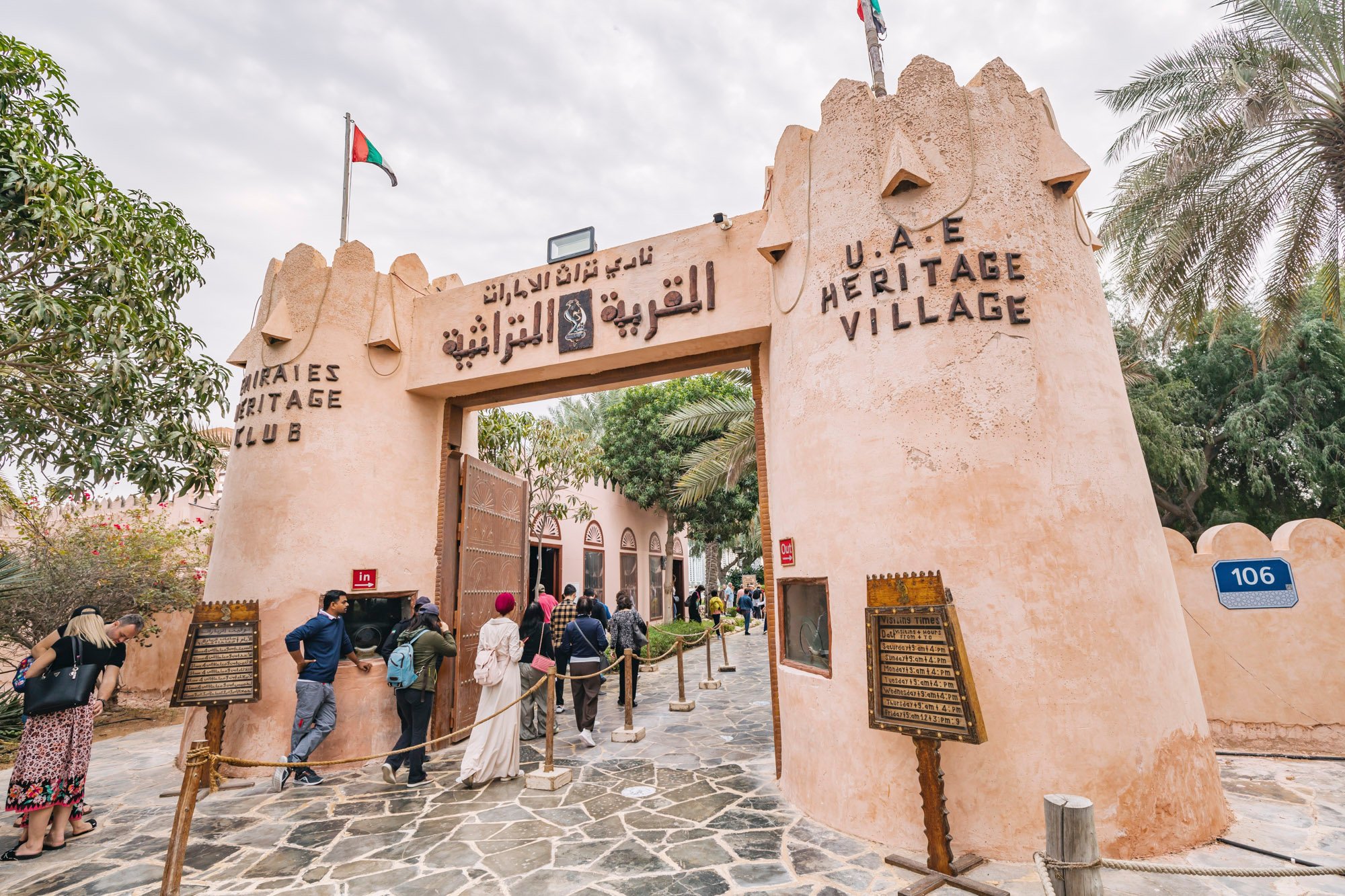
From the Breakwater, the towers of the Corniche look close enough to count. On this side of the water stands a cluster of low palm-frond houses, a small fort with a wind tower, a mosque and a market, all of them made to recall the way people lived along this coast before the discovery of oil.
Heritage Village was created by the Emirates Heritage Club and opened in April 2001 by Sheikh Sultan bin Zayed Al Nahyan, then Deputy Prime Minister and the club’s chairman. Its purpose, from the start, was to gather in one place the strands of an older way of life: fishing and pearling on the coast, farming in the oases, and the movement of Bedouin families and their herds across the desert. The buildings are reconstructions, and they offer a compact, walkable picture of how those three ways of life were organised, and of how much each depended on the materials closest to hand.
Homes Built for the Heat
The barasti houses, put together from the trunks and fronds of the date palm, were light, cheap and quick to repair, and in the heat of summer the loose weave of their walls let the breeze through. The same tree supplied food, rope, matting and baskets.
Beside them, the fort holds a small museum of jewellery, old weapons, pearl divers’ equipment and other everyday possessions, and its wind tower shows how moving air was caught high up and drawn down into the rooms below, cooling them without any machinery at all. Elsewhere there is a Bedouin tent, and camels, goats and Arabian horses are kept on the site.
Water, naturally, is never far from the story. The village recalls the irrigation of the palm groves too, a reminder that settled life in this country grew up wherever water could be drawn from wells or channelled through the falaj systems of Al Ain.
Craft in the Making
The workshops are worth the longest stop. On any particular day, artisans may be throwing pots, blowing glass, working metal, spinning yarn or weaving, and some may let a visitor try a hand at it under supervision. The programme varies from day to day, so it is worth asking which crafts are being shown.
The weaving repays closer attention. Al Sadu, the weaving tradition of the Bedouin, uses sheep’s wool, goat hair and camel hair, worked into boldly patterned textiles that once furnished tents and homes and decorated the trappings of camels and horses. It was, for generations, women’s work, and it was learnt in company: according to UNESCO, weavers gathered in small groups, sometimes chanting or reciting poetry as they worked, while girls learnt by watching before they were trusted with simple tasks of their own.
The tradition has had a heartening recent history. UNESCO first inscribed Al Sadu in 2011, on its list for urgent safeguarding, and the UAE followed with more than a decade of research, documentation and training. In December 2025, meeting in New Delhi, UNESCO’s committee moved Al Sadu to the Representative List of the Intangible Cultural Heritage of Humanity and selected the safeguarding programme itself as an example of good practice for others to follow.
Khoos, the weaving of palm leaves, is humbler but no less ingenious. One of its most familiar forms is the al jafeer, a sack-shaped basket used on the coast to carry fish and inland to carry dates and market purchases. It is started at the base, which goes by the name badwah, meaning beginning, and is then sewn upwards in a spiral until it reaches about an arm’s length, when two handles are added; a basket taller than that is known as a mizmah. They are still made, and they still appear at weddings, filled with sweets for the guests.
The Sea That Built a City
For all the attention given to the desert, much of Abu Dhabi’s early livelihood came from the sea. Fishing fed families, and pearling, for a few hot months each year, brought the income on which whole communities depended, with dhows carrying divers out to the oyster banks and keeping them there until the season closed.
The village does justice to that history. Its displays of boats and diving equipment show the tools of a trade that was physically hard and closely organised, with divers working on a single breath while the crew above handled the ropes and the haul. Songs sung on board helped to keep the rhythm of the work.
Abu Dhabi’s Older Places
The village pairs well with two older sites in the capital.
In the centre of the city, Qasr Al Hosn began as a watchtower built around 1761, in the time of Sheikh Dhiyab bin Isa Al Nahyan, to guard a well. It grew into a fort and later a palace, and after years of careful restoration it reopened to the public in December 2018. Within its grounds, the House of Artisans is given over to the practice and teaching of Emirati crafts, so a skill first glimpsed at the village can be taken further there.
Further out, on Hudayriyat Island, the Hudayriyat Heritage Trail opened in November 2020 to protect archaeological remains on the island. Among them are shell middens, mounds of discarded oyster shells that record the work of the pearl fishermen who once lived there, together with the bones of dugong and shark. Here the evidence is original, and a boardwalk lets visitors follow it along the shore. The island has since become a place to live as well as to visit, with new residential communities such as Al Naseem, developed by Modon, now taking shape.
Visited in a single day, the fort, the village and the trail make a sensible sequence, moving from the seat of government to the household and on to the working shore.
Planning a Visit
The village stands on Breakwater Road, near Marina Mall, a short drive from the Corniche and the city centre. According to Abu Dhabi Culture, it is open from 9am to 4pm, except on Fridays, when it opens from 7.30am to noon and again from 3pm to 9pm. Admission is free. Hours and demonstrations do change from time to time, so it is worth checking before setting out.
The cooler months suit it best, since much of the village is outdoors. As a rule, an hour will do for a walk round, and two allow time to stand at the workshops and watch for a while, which is where the real interest lies. A woven basket or a length of Sadu cloth looks simple enough on a shelf, and it is only by watching one take shape, row upon row, that the hours behind it, and the years of practice behind those, become apparent.