Published: 3 November 2026
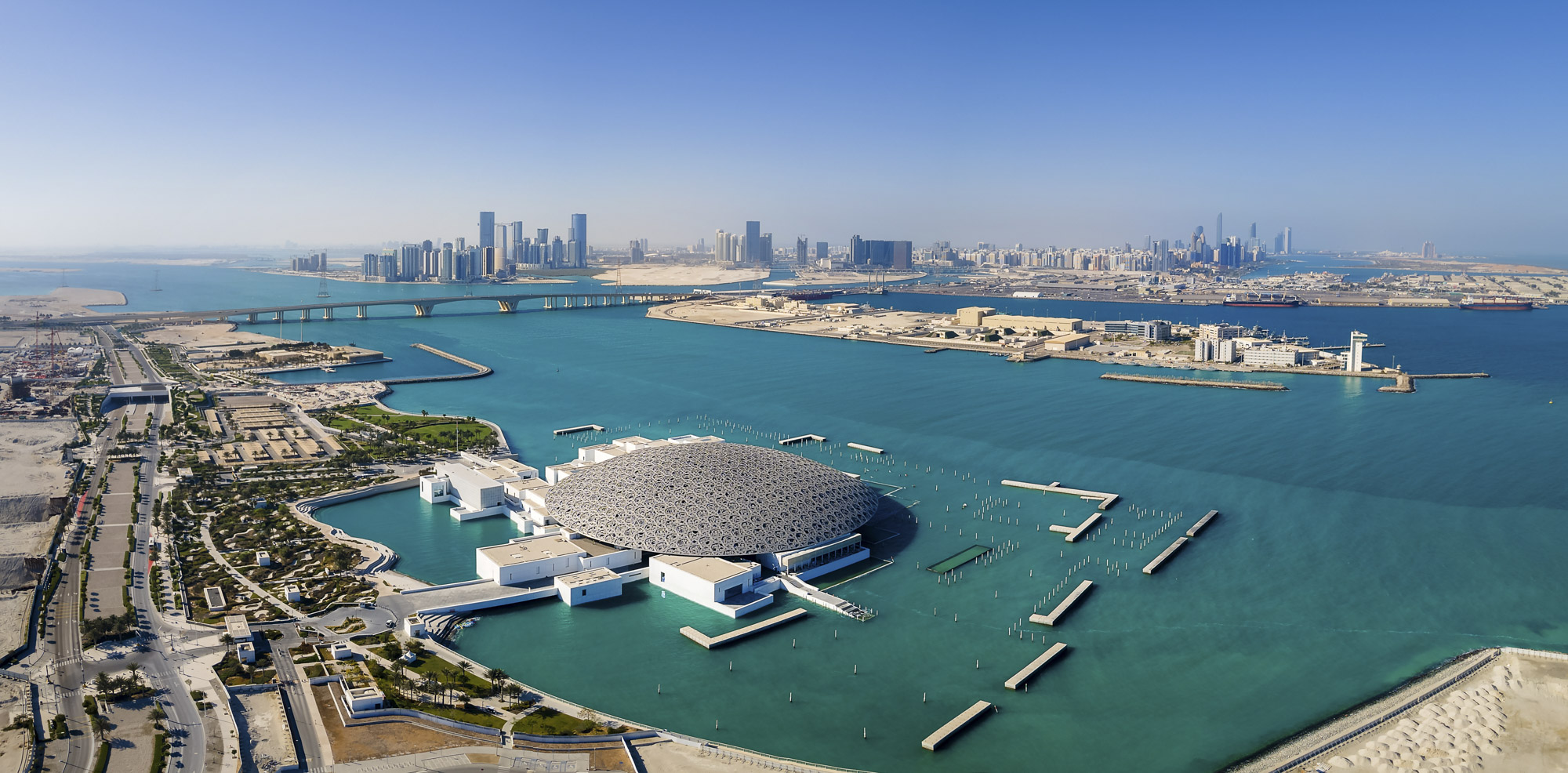
On the western edge of Saadiyat Island, between Louvre Abu Dhabi and the open water, a cluster of angular, rock-coloured volumes rises from the shore. This is the Natural History Museum Abu Dhabi, built for the Department of Culture and Tourism. His Highness Sheikh Khaled bin Mohamed bin Zayed Al Nahyan, Crown Prince of Abu Dhabi, inaugurated the museum in November 2025, and it opened to the public on the 22nd of that month.
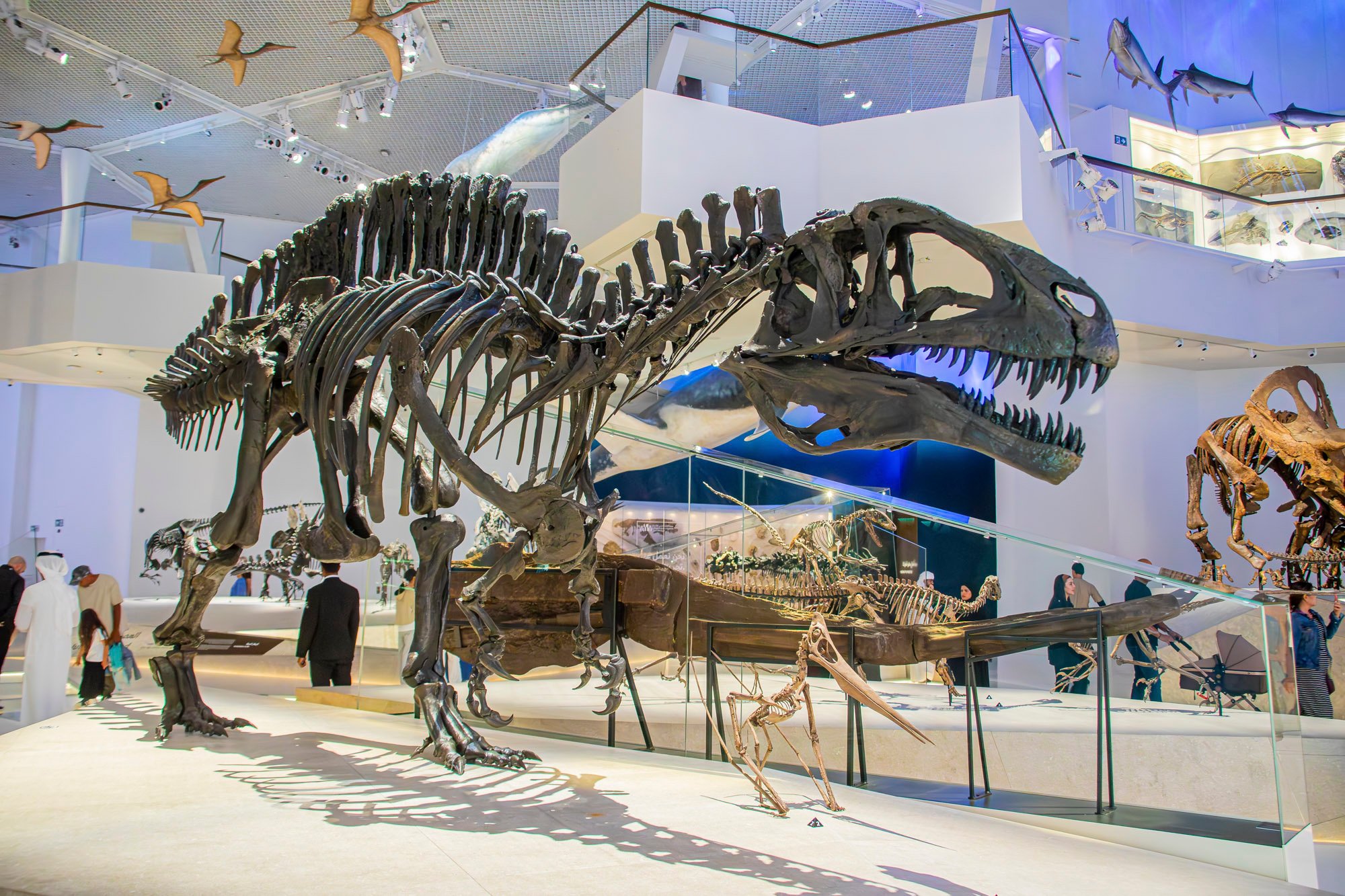
Its ambitions are considerable. Across 35,000 square metres, the museum sets out to tell the story of 13.8 billion years, from the Big Bang to the present day, and it has gathered some of the most celebrated specimens in natural history to do so. Behind the galleries, meanwhile, it also works as a research institution, with laboratories for palaeontology, zoology, marine biology, molecular research and the earth sciences.
Yet its most surprising chapter concerns the ground beneath the visitor’s own feet. Somewhere in the Al Dhafra desert, some 250 kilometres from the city, a single line of footprints runs for 260 metres across a flat stretch of rock. A lone male elephant made them about seven million years ago, walking beside a river that has long since vanished. Nearby, in the same rock, are the prints of a whole herd of females and their young, moving together much as elephants do today. It is the earliest known evidence of that kind of social life among elephants anywhere, and it was found not in Africa but in Abu Dhabi.
The Lost Rivers of Al Dhafra
Between six and eight million years ago, the region was crossed by a broad, braided river, its channels shallow but running all year round. The coast then lay some 300 kilometres further east than it does now. Along the banks lived hippopotamuses, several kinds of giraffe and antelope, crocodiles and a giant land tortoise, all preserved in what geologists call the Baynunah Formation.
The best known of these animals is Stegotetrabelodon emiratus, an extinct elephant with tusks in both its upper and lower jaws. Its remains, together with the jaw of an early hippopotamus found on the island of Shuwaihat, give the museum something no foreign loan could supply: a direct record of what the emirate once looked like. Anyone who has driven out across those dunes will find the idea of crocodiles basking there hard to picture.
A Building Shaped Like Terrain
Mecanoo approached the museum less as a single object than as a piece of landscape, its stacked forms taking their cue from the wadis and outcrops of the Arabian Peninsula. Pentagonal shapes, drawn from the cellular structures found in living things, recur from the scale of the façade down to its smallest details.
The building sits on a site of 82,000 square metres, and it was designed and built in a little over five years. Three public pathways cut through the grounds, linking the waterfront with the neighbouring museums, and anyone may use them without a ticket.
Inside, deep skylights bring daylight down into an atrium that Mecanoo intended to feel like standing within a geological formation. Here the first exhibit is already waiting: a herd of five long-necked sauropods, each of a different species, which the museum believes to be the first such display anywhere. Their necks reach up towards the light, and few visitors walk past them without stopping.
From the Big Bang to Earth’s Future
The permanent galleries follow time forwards. The Story of Earth begins with the origins of the universe and the solar system. The Evolving World traces the long history of life, and Our World turns to the living planet as it is today. The sequence ends with Resilient Planet and Earth’s Future, which look at change still under way. Smaller galleries branch off along the route, including a working palaeontology laboratory and rooms devoted to Arabia’s climate and the human story.
The oldest object on display is also one of the least imposing. The Murchison meteorite fell near the town of that name in Victoria, Australia, in 1969, and the museum’s piece contains microscopic grains around seven billion years old. The rock itself formed with the solar system, some 4.6 billion years ago. The grains inside it, however, are older still, dust from stars that burned out before the Sun was born.
At the other extreme of scale hangs the skeleton of a female blue whale, 25 metres long and the largest animal known to have lived.
Stan
For many visitors, though, the dinosaurs will come first. The museum’s best-known resident is Stan, one of the most complete Tyrannosaurus rex skeletons ever found, around 67 million years old and named after the amateur palaeontologist who came across it in South Dakota.
In Abu Dhabi, Stan is not shown standing politely on a plinth. He faces a second T. rex across the carcass of a Triceratops, whose bones still carry the marks of bites. Two fossil tyrannosaurs have never before been mounted together in such a scene, the museum says. It makes for a dramatic tableau, certainly, and a useful lesson in how palaeontologists read a skeleton, from the angle of a hip joint to the scar left by a tooth.
When Fossils Come to Auction
Stan’s journey to Saadiyat is a reminder that great fossils sometimes pass through private hands on their way to public view. In July 2024, at Sotheby’s in New York, a Stegosaurus skeleton known as Apex realised $44.6 million, against a pre-sale estimate of $4 to $6 million. Discovered in Colorado in 2022, it is the largest and most complete Stegosaurus yet found, with 254 of its roughly 319 bones preserved. Sotheby’s described it as the most valuable fossil ever sold at auction.
Its buyer, the financier Ken Griffin, did not keep it out of sight. Five months after the sale, Apex went on display at the American Museum of Natural History in New York, on a loan intended to last four years and open to researchers as well as the public. Collecting and scholarship, in other words, need not pull in opposite directions.
A Museum Within Reach
The museum now stands in the Saadiyat Cultural District alongside Louvre Abu Dhabi and Zayed National Museum, and a single Museums Pass covers all three. Barely a fortnight after it opened, the collecting world gathered on the same island for Sotheby’s inaugural Abu Dhabi Collectors’ Week, whose auctions on Saadiyat Beach brought in a combined $133.4 million.
Its arrival has also entered the conversation about the island’s residential future. Leigh Borg, Managing Director of Abu Dhabi Sotheby’s International Realty, has pointed to the Natural History Museum as one of the institutions shaping the capital, speaking after the firm’s landmark sale on Saadiyat Island: a penthouse at Four Seasons Private Residences on Saadiyat Beach, sold for AED 200 million.
For those who live nearby, the museum’s value will be quieter and more lasting. It repays repeat visits, and its displays will change as new research arrives. Families can treat it as a regular Saturday morning rather than a single expedition, and at opening, admission was free for children under 18.
It is worth leaving time, before going home, to look again at the pieces from Al Dhafra. The river that fed those elephants dried up long ago, but the footprints remain, and they are, in their way, the museum’s most local exhibit.