Published: 13 July 2026
Whether seen through its white domes, vast ceremonial halls or evening light show, Qasr Al Watan holds a public profile that few modern civic buildings in the region can match. Yet the palace is not simply a landmark or visitor attraction. It is an active presidential palace, a setting for state ceremony and diplomacy, and a building designed to help visitors understand the UAE’s governance, heritage and traditions of knowledge.
Opened to the public in 2019, Qasr Al Watan meaning the Palace of the Nation in Arabic – stands in Al Ras Al Akhdar, near the Abu Dhabi Corniche. Its name matters. This is not a former royal residence turned museum, but a working palace that presents the nation’s civic identity through architecture, craftsmanship, literature and diplomacy.
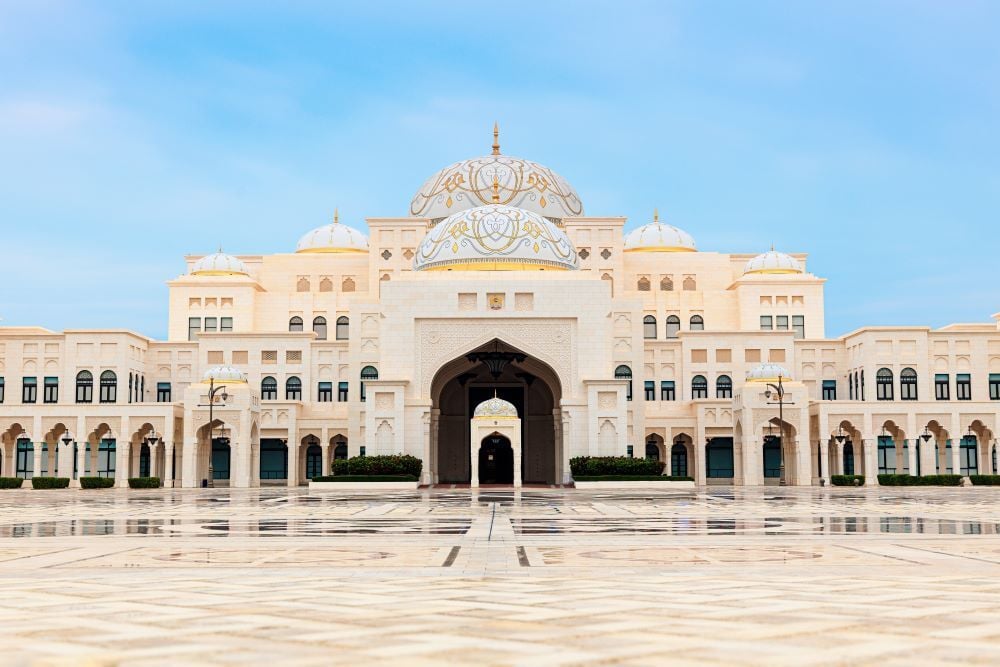
A Palace with a Public Purpose
Qasr Al Watan was not opened to the public simply to show visitors a grand building. Its visitor route aims to explain the ideas behind Emirati and Arabian design, the institutions that shaped the UAE, and the knowledge traditions that have long mattered in the region.
That public role gives the palace its particular character. In many countries, presidential palaces are closed settings, seen only during state visits, official photographs or evening news bulletins. Qasr Al Watan takes a different approach. It remains a venue for formal state use, but its public rooms allow residents and travellers to see how the building presents ideas of unity, continuity, knowledge and service.
Although contemporary, the palace draws on symmetry, domes, geometric pattern and finely worked Arabian craftsmanship to create a sense of order and permanence. This is not mere decoration; in a civic building, design is also a form of communication – and here it gives official life a measured, recognisably Emirati setting.
For Abu Dhabi, the openness of Qasr Al Watan also fits a wider cultural direction. Over the past two decades, the capital has invested in museums, archives, restored heritage sites and major cultural districts. The palace belongs to that story, but with a more formal note. It is a visitor attraction, certainly, but also a working building through which the UAE presents its understanding of government, heritage and public service.
Architecture in White Stone
The first impression is one of order and light. Qasr Al Watan’s light-toned exterior, formal symmetry and domed roofline give the palace a commanding presence, while its arches, geometry and carved detailing keep it closely tied to Islamic and Arabian architectural traditions. White granite and limestone are commonly associated with its façade, while inside, marble, carved surfaces, patterned detail and controlled reflection give the building its finely worked character.
The palace uses familiar elements – domes, arches, arabesque carving, symmetry and processional spaces – within a contemporary state setting, which is part of its strength. Qasr Al Watan looks back to regional traditions of geometry, craftsmanship and majlis culture, while serving modern purposes such as diplomacy, public ceremony and national education.
The Great Hall gives this idea its strongest form. At the centre of the palace, its vast dome and lofty proportions draw the eye upwards, before the detail below brings the room back to a more human scale. Arches, panels, inlaid surfaces and finely worked patterns soften the size of the space, giving it rhythm without fuss. It feels ceremonial, certainly, and entirely in keeping with the palace’s formal character.
The mirrored cubes in the Great Hall add a curious detail. Rather than acting as decoration alone, they allow visitors to study the dome and upper surfaces from below, catching views that would otherwise be missed.
The Spirit of Collaboration
Beyond the Great Hall, the palace’s state function becomes more visible. The Spirit of Collaboration is one of Qasr Al Watan’s most important rooms, used for meetings of the UAE Cabinet and the Federal Supreme Council, the country’s highest constitutional authority.
The name is not incidental. The UAE’s federal structure rests on the relationship between its seven emirates, and the hall’s circular layout reflects that idea of shared decision-making. In the centre hangs a 12-tonne chandelier, a remarkable piece of craft in its own right. The Presidential Meeting Room belongs to the same diplomatic rhythm, used during state visits and official receptions. Qasr Al Watan is, after all, a working palace connected to real protocol.
Banquets, Gifts and Diplomacy
Formal hospitality has long been part of diplomacy, and Qasr Al Watan gives this tradition a visible home. The Presidential Banquet Hall is used for major state occasions, including official meals for visiting dignitaries. It is arranged to communicate order, welcome and respect. Tableware, silver, crystal and service traditions all become part of the ceremony.
The Presidential Gifts exhibition adds another layer. Diplomatic gifts are rarely neutral objects; they are chosen to carry taste, history and craft traditions. At Qasr Al Watan, they are shown as records of friendship and exchange, from ceremonial vessels and textiles to manuscripts and finely worked pieces.
For visitors, this part of the palace brings diplomacy closer to everyday understanding. A gift, a formal meal, a meeting marked with care: each gesture has its place. Agreements matter, of course, but relationships between nations are also shaped through ritual, symbolism and personal encounter.
The Library and House of Knowledge
Qasr Al Watan is also a palace of books. The Qasr Al Watan Library and the House of Knowledge shift the focus from ceremonial rooms to the UAE's intellectual and cultural history. The Library brings together works on the country's cultural, economic, political and social development, while the House of Knowledge traces Arab scholarship across subjects including medicine, astronomy, statecraft and the humanities.
These galleries give the palace a different pace. Alongside grand halls and formal meeting rooms are manuscripts, books and exhibitions that place the UAE's story within a much longer tradition of learning and scholarship.
That wider context matters. Arab contributions to mathematics, astronomy, medicine, language and philosophy are often explored in museums or universities. Here, they sit within a working presidential palace, linking government with the exchange and preservation of knowledge.
The Power of Words
Among the palace's most recognisable contemporary works is The Power of Words, a calligraphic sculpture by Emirati artist Mattar Bin Lahej. It is based on a quotation by the UAE's Founding Father, Sheikh Zayed bin Sultan Al Nahyan: "Wealth is not money or oil; wealth lies in people, and it is worthless if not dedicated to serve the people."
The sculpture brings together public art, language and national history. Arabic calligraphy has long held a central place in the region's artistic tradition, and here it carries a message closely associated with the palace itself. Placed within a working presidential palace, the sculpture feels entirely at home. It reflects the emphasis Sheikh Zayed placed on people and public service as the country's greatest source of wealth.
Planning a Visit
Qasr Al Watan is located in Al Ras Al Akhdar, close to the Abu Dhabi Corniche. Visitors coming from Dubai can take Sheikh Zayed Road, the E11, towards Abu Dhabi, then continue towards Corniche Street and Qasr Al Watan. From Saadiyat Island or Yas Island, the official route runs via Sheikh Khalifa Bridge, the E12 and Corniche Street. On arrival, a free shuttle takes visitors from the Visitor Centre to the palace entrance.
As Qasr Al Watan remains a working presidential palace, opening hours and access can change. It is worth checking the official site before travelling, particularly for the Palace in Motion light show, where last entry is 30 minutes before the show begins.
Dress is another practical point to get right. Visitors are asked to cover shoulders and knees; shorts, sleeveless tops and see-through clothing are not permitted. Comfortable shoes are sensible, while flip-flops and very casual footwear are best avoided.