Published: 5 November 2026
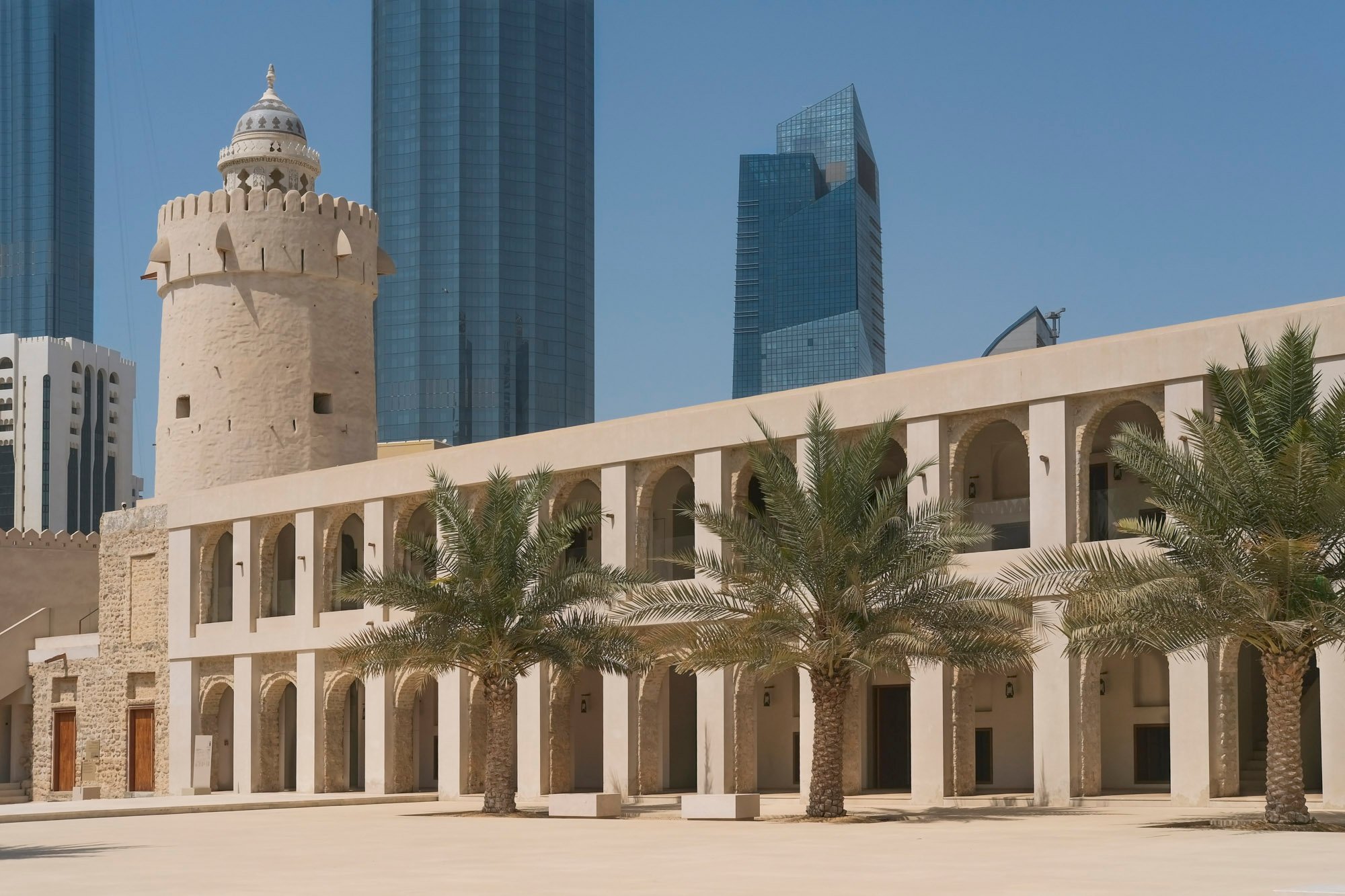
The earliest walls of Qasr Al Hosn came out of the sea. Divers cut coral from the shallows in blocks, which were then left to harden in the sun, and chippings of the same stone were burnt to a powder that, mixed with water, served as mortar. The round tower raised from that material still stands in the heart of Abu Dhabi, set within the white walls of a much larger palace and looked down on, these days, by the towers of the city that grew up around it.
Its beginnings are bound up with water. According to local tradition, a hunting party from Liwa, the oasis settlements deep in the desert to the south-west, found fresh water on the island, and a settlement gradually took root beside it. In the 1790s, Sheikh Dhiyab bin Isa Al Nahyan ordered a watchtower to be built to guard the island’s only freshwater well and to keep watch over the coastal trade routes beyond it. That tower was the first permanent structure in what would become Abu Dhabi, and Abu Dhabi Culture now describes Qasr Al Hosn as the oldest and most significant building in the capital.
A Fort for a New Seat of Power
The tower did not stand alone for long. Sheikh Shakhbut bin Dhiyab, who ruled from 1793 to 1816, ordered further towers and had them linked into a defensive enclosure, and in 1795 he moved the seat of power from Liwa to the island. The Inner Fort dates from that year. It was his home as well as his seat of government, a double role carried in the name itself, since qasr means palace in Arabic and hosn means fort.
Later rulers added to it in turn. Sheikh Tahnoun bin Shakhbut, who ruled from 1818 to 1833, enlarged and strengthened the fort, and the town outside prospered on the strength of the sea; by the late 1800s Abu Dhabi had more than 400 pearling boats, the largest number in the Gulf. Sheikh Zayed bin Khalifa, remembered as Zayed the Great, reigned from 1855 to 1909, longer than any other ruler in the emirate’s history, and introduced a raised platform outside the north-west tower so that a majlis could be held there. The fort appears in photographs taken by Samuel Zwemer in 1901 and Hermann Burchardt in 1904, in the final years of his rule.
A Palace Around the Fort
The largest change came in 1939, when Sheikh Shakhbut bin Sultan Al Nahyan negotiated the emirate’s first oil concessions. Part of the proceeds paid for a new palace, built between 1939 and 1945. The Outer Palace enclosed the founding walls rather than replacing them, tripling the size of the site, and in the early 1950s a decorative arch was added outside the gates.
For nearly two centuries the building served the Al Nahyan family as a residence, and for much of that time it was the seat of government too, so that the household and the business of the emirate were conducted under one roof. In the second half of the twentieth century the city’s growth quickened, with roads laid across the desert and new buildings rising on every side, and the old fort became the fixed point of a fast-growing capital.
The Chamber Beside the Fort
Between 1968 and 1970, Sheikh Zayed bin Sultan Al Nahyan founded the National Consultative Council, whose chamber stands beside the fort. In 1971 it was one of the settings for the negotiations that led to the union of the emirates, and national and federal debates continued to be held there until the late 1990s.
Sheikh Zayed saw to the fort's future as well. In the 1980s he ordered its restoration and its conversion into a centre for documentation and research, and for a time the complex housed a national archive. Close by, the Cultural Foundation, which he had envisioned, opened in 1981 with the country’s first National Library, a performance auditorium and an exhibition centre. The architect Hisham Al Ashkouri refined the winning competition design and led the project.
Eleven Years of Conservation
The conservation plan that preceded the museum began with the discovery of corrosive moisture trapped in the old masonry. The guiding principle, reportedly, was to do “as little as possible, but as much as is needed”, and in practice that meant resisting the temptation to return the whole complex to a single date. The watchtower has been conserved to its earliest phase, while the Inner Fort reflects its appearance in the 1980s and the council chamber has been reinstated as it looked in the 1970s and 1980s. The team also drew on the logic of traditional building. Roofs in Emirati vernacular architecture rested on chandal, poles of mangrove wood, which kept the span of a room to around three metres, and that measure became one of the clues used to read the different phases of the fort.
Plans changed, naturally, as the building was better understood. The original scheme considered air-conditioning the 1940s palace for museum use, but the older fabric and traditional building methods uncovered during the work prompted a rethink, and the palace now demonstrates the natural cooling its builders depended on, through thick walls and channelled breezes.
After more than eleven years of conservation and restoration, Qasr Al Hosn was opened as a museum in December 2018 by His Highness Sheikh Mohamed bin Zayed Al Nahyan, then Crown Prince of Abu Dhabi, and a week of celebrations followed for the public. Its displays include objects dating back as far as 6000 BC and follow Abu Dhabi’s growth from a fishing and pearling settlement into a modern capital.
The Al Hosn Site Today
The fort is the focus of a wider cultural site. At the House of Artisans, training courses and workshops keep Emirati crafts in use. Al Sadu, the geometric wool weaving of Bedouin women, is taught there alongside khoos, the braiding of date-palm leaves practised by men and women alike, and talli, an embroidery worked in cotton or silk threads mixed with gold or silver along the collars, sleeves and hems of traditional dress.
At Bait Al Gahwa, Arabic coffee is served with dates. The Cultural Foundation, meanwhile, now has a 900-seat theatre and the Abu Dhabi Children’s Library.
Planning a Visit
Qasr Al Hosn stands on Sheikh Rashid bin Saeed Al Maktoum Street, in the centre of Abu Dhabi. According to Visit Abu Dhabi, entry to the House of Artisans and the surrounding grounds is free, while the fort itself is ticketed, as are special workshops and events. Opening hours are best checked on the official Qasr Al Hosn website before setting out.
It makes sense to start at the round watchtower, which is, after all, where Abu Dhabi began. Everything else on the site was added around it by successive rulers over the better part of two centuries, and the coral at its core came from the same shallows that once gave the town its living.