Published: 5 November 2026
More than 200 of the trees in Umm Al Emarat Park were already over twenty years old when the redevelopment began, and rather than clear them, the designers had them lifted, stored and replanted in the new grounds. They are the park’s oldest link with Mushrif Park, which opened in 1982 as a garden reserved for women and children and grew into one of the largest and oldest of Abu Dhabi’s parks. Around them, the redevelopment added some 1,200 new trees and 150,000 shrubs.
The History of Umm Al Emarat Park
Mushrif Park closed in January 2013 for a redevelopment planned to take 24 months. Al Ain Properties led the project with an international team of designers, architects and contractors, and the park reopened in March 2015 as Mushrif Central Park, now open to everyone. In 2016 it was renamed Umm Al Emarat Park, the Mother of the Nation Park, in honour of Her Highness Sheikha Fatima bint Mubarak, Chairwoman of the General Women’s Union, President of the Supreme Council for Motherhood and Childhood and Supreme Chairwoman of the Family Development Foundation. The new name keeps faith with the park’s first purpose as a place for mothers and their children.
The design was conceived as a tribute to the late Sheikh Zayed bin Sultan Al Nahyan and his belief in preserving the country’s natural and cultural heritage for future generations, and it was quickly recognised. In 2015 the park received a Merit Award for Design from the American Society of Landscape Architects, followed by the international Green Flag Award, the benchmark for well-managed parks and green spaces, in both 2016 and 2017.
Gardens, Water and Shade
According to the park, its masterplan combines the principles of the traditional Islamic garden with contemporary garden design, and the influence shows in the way water and shade are used across the grounds. Nowhere is shade taken more seriously than in the Shade House, a pavilion 30 metres high that holds some 40 plant species, among them shade-loving palms and cycads, in a moisture-controlled environment. Paths wind through the planting before climbing to two upper decks, from which the lawns and gardens can be seen laid out below.
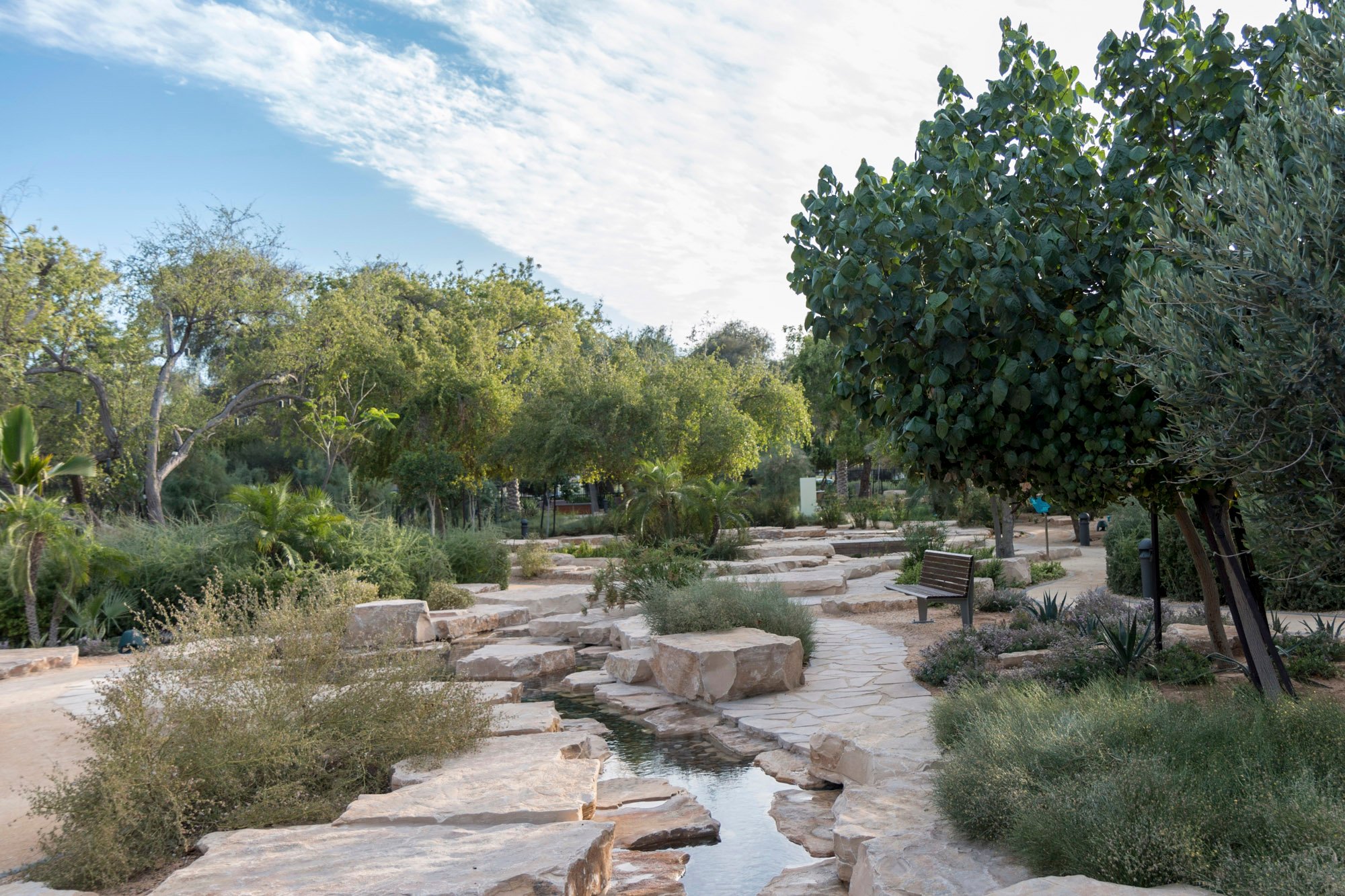
The Botanic Garden is planted with more than 200 regional species, many of them with cultural and historical significance in the Arabian Peninsula, and its centrepiece is a calm natural pond with pools of natural stone joined by small cascading streams. A short walk away, the Wisdom Garden honours Sheikh Zayed’s work for conservation, with quotations from the Founding Father carried on marble walls among the planting. It is a place for reflection, set a little apart from the busier lawns.
The park’s link with the country’s natural heritage extends to its sculpture. Five life-sized bronzes known as the Jewels of Abu Dhabi, representing the dugong, the greater flamingo, the hawksbill turtle, the Arabian oryx and the saker falcon, are on permanent display. They were a Mother’s Day gift to Sheikha Fatima from His Highness Sheikh Hamdan bin Zayed Al Nahyan, Chairman of the Environment Agency – Abu Dhabi, and each represents a species the emirate has worked to protect.
Things to Do at Umm Al Emarat Park
Much of the park’s everyday life happens on the Great Lawn, an open expanse of 18,000 square metres used for football, outdoor yoga or simply sitting in the shade at the edges. Two playgrounds beside it offer climbing cubes, exercise stations and sensory activities for younger children.
The Children’s Garden has a cooling wadi and interactive fountains for warmer days, and in past winter seasons it has also served as an open-air cinema. At the Animal Barn, run in partnership with Al Ain Zoo, the residents include goats, ponies, rabbits, tortoises, emus and camels, with the animals changing seasonally. Some can be fed, and pony rides run from four in the afternoon.
For families, the appeal is that none of this needs planning. Younger visitors can move between the barn and the playgrounds while their parents stay on the lawn or find a table at one of the park’s cafés.
Evenings and Seasonal Events
The park stays open until midnight, and the cooler months bring much of its programme into the evening. The Amphitheatre, an outdoor venue with room for more than 2,000 people and its own water fountain, hosts concerts, performances and community events, while the Evening Garden offers a pavilion for those who would rather read or work in peace.
The winter calendar changes from year to year. The 2025–26 season, for instance, brought the Park Market to the promenade and the Children’s Garden every Friday and Saturday from October to April, with more than 60 local vendors selling food, sweets and handmade goods and entry included in the park ticket.
A Neighbour to Al Mushrif
Al Mushrif, with its established villas and tree-lined residential streets, is one of the capital’s older family neighbourhoods, as Abu Dhabi Sotheby’s International Realty’s guide to the best areas in Abu Dhabi describes. For those living nearby, a public garden on this scale is a practical advantage, close enough for an evening walk or an hour with the children to become part of the ordinary week, with no need to travel to one of the capital’s larger leisure destinations.
Visiting Umm Al Emarat Park
Umm Al Emarat Park is located on 15th Street in Al Mushrif, between Airport Road and Al Karamah Street, close to the International School of Choueifat. It is open daily from 8am until midnight, with last entry at 11pm. The park's calendar includes seasonal markets, cultural performances and family activities, with the cooler months offering the most comfortable conditions for enjoying its outdoor spaces.
An afternoon in the gardens can easily extend into the evening, with time for a walk beneath the palms, a visit to the botanical collections or a performance at the Amphitheatre. Among the newer planting stand mature trees preserved during the park's redevelopment, some of them already well established when Mushrif Park welcomed its first visitors in 1982.