Published: 9 June 2026
Abu Dhabi's first three months of 2026 have completely redefined a market that was already showing robust growth. Real estate in the emirate recorded its strongest quarter on record, with transaction values rising 160.7% year-on-year to AED 66 billion. To put that in context: the entire year of 2025 delivered AED 142 billion in transactions, itself a 44% increase on the prior year. Abu Dhabi has now matched nearly half of that extraordinary annual total in a single quarter.
“If we look at the broader picture of Abu Dhabi and what’s happening across the market in 2026, there is a very clear message”, says Chris Cina, Managing Director - Head Project Developments for Abu Dhabi Sotheby’s International Realty. “The UAE capital is building a world-class ecosystem where lifestyle, culture and capital converge and strengthen each other.” Chris has tracked the movement of the market carefully and has seen a surprising upward trajectory that shows no sign of levelling out this year.
The Numbers in Full
Sales and purchases in Q1 2026 totalled AED 50.97 billion through 8,940 transactions, reflecting a 228.6% increase in value and a 134% rise in volume compared to Q1 2025. Mortgage transactions reached AED 15.03 billion through 4,578 transactions, representing a 53.4% increase in value and a 48.8% rise in volume year-on-year. The breadth of this performance, spanning both transactional and financing activity, signals that this is not simply a surge in speculative off-plan buying. End-user demand and conventional mortgage financing are moving in tandem, suggesting a market building on sustainable foundations rather than pure sentiment.
Off-plan activity dominated at AED 35.3 billion, while the ready segment expanded meaningfully to AED 13.5 billion, signalling sustained investor appetite alongside growing end-user demand.
The rental market is equally telling. The repeat lease price index recorded a 16% annual increase compared to March 2025, underscoring continued demand from end users and investors. When rents rise at that pace, the investment case for ownership strengthens accordingly.
Foreign Capital: A New Scale of Confidence
Perhaps the most striking data point in ADREC's Q1 report concerns foreign direct investment. Total FDI from individual investors reached AED 8.27 billion, an increase of 423% compared to Q1 2025, and equivalent to the total foreign direct investment recorded across the entirety of 2025. Investors from 99 nationalities contributed to this performance, up from 68 nationalities during the same period last year. Key contributing markets included the UK, India, Russia, China, Jordan, France, and Egypt.
The broadening of the investor base is as important as its volume. A market drawing capital from 99 countries is no longer a regional story, but a global one. Foreign investment activity within investment zones accounted for approximately 84% of total investment value, surpassing AED 36.4 billion.
Rashed Al Omaira, Director General of ADREC, framed the moment with characteristic precision: "This quarter's performance is a clear reflection of the confidence Abu Dhabi continues to earn from investors both locally and internationally. Reaching a record level of demand signals a market that is becoming more disciplined, with a clear focus on long-term investment."
Resilience Under Pressure
The context in which these figures were posted deserves emphasis. Regional conflict broke out on 28 February 2026, yet transaction volumes from March to May ran nearly 58% above the same period in 2025. Residential transaction activity surged 119% year-on-year in Q1, with approximately 7,800 deals recorded, reflecting a 10% increase quarter-on-quarter. That is not a market pausing to take stock; it is a market accelerating through uncertainty.
This resilience reflects a structural shift in how investors perceive Abu Dhabi. The emirate has long positioned itself as a haven of political stability within a volatile regional landscape. In 2026, that reputation is being tested in real time, and the market's response constitutes the most credible endorsement possible.
The Developer Moment
Institutional confidence at the investor level is matched by developer conviction on the ground. Modon launched Hudayriyat Golf Estates, anchored by the emirate's first championship golf course. Hudayriyat Island itself was the leading area for real estate transactions, recording deals amounting to approximately AED 11.97 billion.
The most consequential launch of the year, however, came in April when Sobha Realty entered the Abu Dhabi market for the first time in its 50-year operating history. Sobha City, valued at AED 40 billion, spans 38 million square feet in Al Bahiya, close to Zayed International Airport and Yas Island. Once complete, the development is expected to include approximately 4,000 apartments and 2,500 villas, alongside 80 exclusive mansions. Nearly 60% of the project is dedicated to open and green spaces, with over 50,000 trees and an 18-kilometre wellness loop. Sobha's managing director was direct about his reading of the market: international buyers, led by purchasers from the United States, Canada, and Europe, account for 60% of Abu Dhabi's residential demand, with UAE residents comprising the remainder.
Meanwhile, supply is being actively managed to prevent the market from overheating. Residential supply in the Abu Dhabi region is projected to increase by 10,272 units in 2026, representing annual growth of 3.3%, controlled enough to sustain the conditions that currently favour capital appreciation.
Institutional Gravity and the Ecosystem Effect
Abu Dhabi's appeal to capital operates across multiple registers simultaneously. Beyond bricks and mortar, the emirate has drawn a concentration of global asset managers to the Abu Dhabi Global Market this year: Man Group, Bain Capital, Capital Group, and Hillhouse Investment have all established ADGM presences in 2026, collectively representing over USD 4.4 trillion in assets under management. When institutions of this calibre elect to plant a flag, they validate the conditions for all categories of investment that follow.
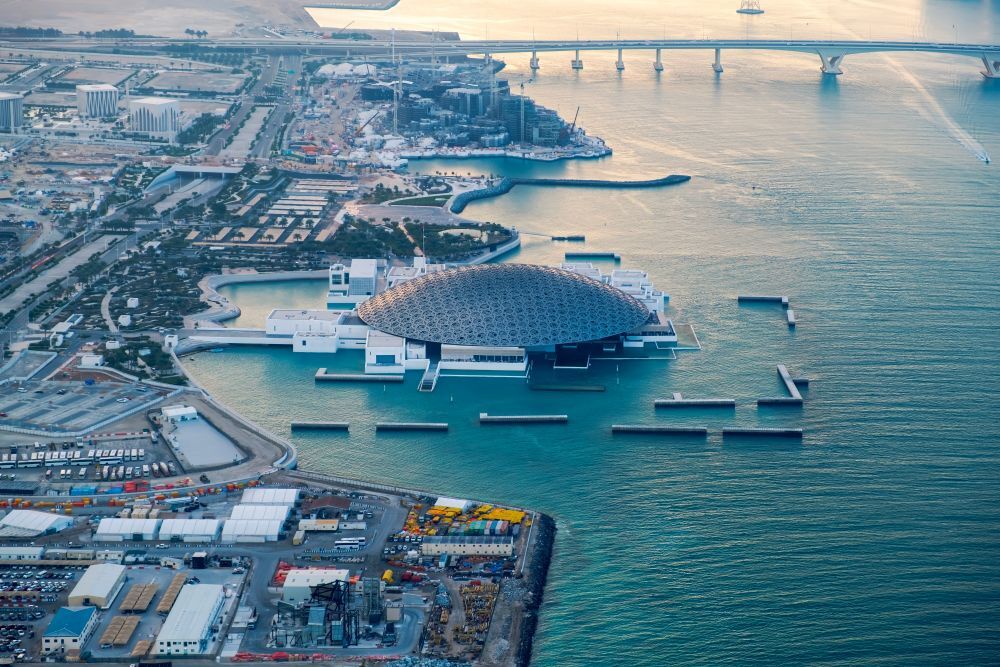
The cultural infrastructure surrounding them reinforces the proposition. The Guggenheim Abu Dhabi's project director confirmed the Frank Gehry-designed museum will open before the end of the year on Saadiyat Island, where it will become the largest museum in the Guggenheim network. Its arrival completes the Saadiyat Cultural District alongside the Louvre Abu Dhabi, the Zayed National Museum, and the Natural History Museum. On Yas Island, the USD 1.7 billion Sphere announcement adds a further dimension to an entertainment and leisure offer already among the most competitive in the world.
The Longer View
Abu Dhabi recorded 7.5% population growth and 7.6% non-oil GDP growth, both of which are important long-term indicators for sustained housing demand. These are not cyclical tailwinds; they reflect a deliberate, decade-long programme of economic diversification that is now producing compounding returns.
The market that delivered AED 66 billion in a single quarter is one that has spent years laying the conditions for exactly this kind of performance. Regulatory clarity through ADREC, freehold expansion into designated investment zones, the Golden Visa framework, and a relentless focus on infrastructure and culture have all converged to produce something that is proving difficult to replicate elsewhere in the Gulf.
What Abu Dhabi is building in 2026 is not a property cycle. It is an ecosystem in which capital, culture, and livability are advancing together, and in which the evidence of the first half of this year suggests the momentum has considerably further to run.
.jpg)