Published: 4 June 2026
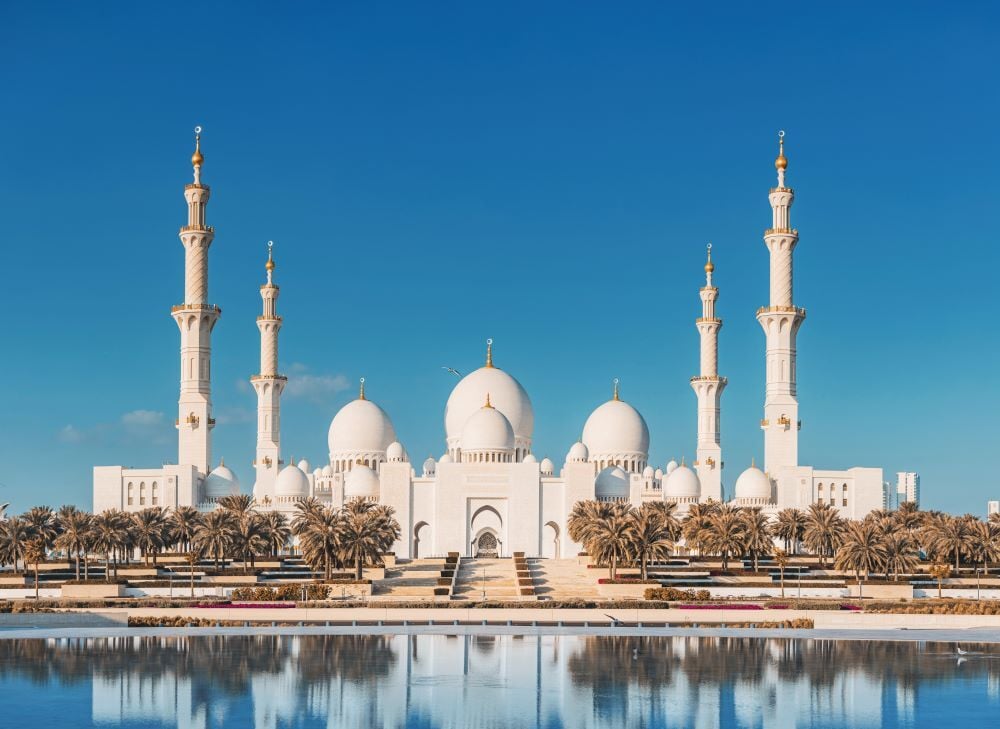
The sacred beauty of Sheikh Zayed Grand Mosque begins with its first encounter between stone and light. Its white marble, chosen for its association with purity, virtue and peace, gives the building an atmosphere of serenity before the eye moves to the finer details: the rhythm of domes and minarets, the blue stillness of the reflective pools, the floral inlays worked into stone, and the calligraphy that gives the interiors their spiritual direction. Every surface appears guided by purpose, turning architecture into an expression of faith, craftsmanship and calm.
Across the mosque, Islamic design is interpreted with remarkable depth. Moroccan and Mughal influences shape the domes, while the minarets bring together forms inspired by several Islamic architectural eras. This layering of traditions gives Sheikh Zayed Grand Mosque its enduring presence as a modern landmark rooted in heritage and spirituality.
Influences and Inspirations
Sheikh Zayed Grand Mosque draws its architectural strength from several Islamic traditions, with its 82 domes offering one of the clearest expressions of this layered influence. Inspired by Moroccan and Mughal styles, the domes give the mosque much of its visual rhythm. The largest dome, positioned above the main prayer hall, measures approximately 32.6 metres in diameter and rises to a height of 84 metres. The domes are finished with white marble cladding, onion-shaped crowns and crescent-shaped finials decorated with gold-glass mosaic.
The four minarets rise to around 107 metres from the corners of the courtyard. Their design combines square, octagonal and circular layers, reflecting different Islamic architectural eras. The word minaret comes from the Arabic “manāra”, meaning a beacon or lighthouse, a fitting origin for structures historically associated with the call to prayer and the spread of knowledge.
The mosque is also a work of international collaboration. According to the Sheikh Zayed Grand Mosque Centre, its design and construction brought together artisans, craftsmen and materials from countries including Italy, Germany, Morocco, India, Turkey, China, the United Kingdom, New Zealand, Greece and the UAE. More than 3,000 workers and 38 contracting companies contributed to its construction.
External and Internal Characteristics
Externally, the mosque is defined by symmetry and ceremonial scale. More than 165,000 square metres of brilliant SIVEC marble from North Macedonia covers the outer surfaces of the domes, minarets and walls. The material was chosen for its quality and pure white colour, which the Centre associates with purity, virtue and peace. Much of the white marble inside the mosque comes from Italian quarries.
The courtyard, or Sahan, gives the building its grand open centre. Used during major prayers, Eid prayers and Ramadan gatherings, it is inlaid with hundreds of thousands of marble mosaic pieces from Italy, India, Greece and China. The floral design brings delicacy to the vast surface, softening the mosque’s scale through colour, rhythm and detail.
Around the mosque, 10 rectangular reflective pools create a quieter edge to the architecture. Tiled in different shades of blue, the pools cover nearly 7,000 square metres of water, cooling the bright shimmer of the white marble and adding depth to the view, especially at night.
Inside, the atmosphere becomes more intimate. Light enters through windows at the base of the domes, while the interiors of the domes feature traditional Moroccan artwork made from reinforced plaster and decorated with Quranic verses in calligraphy styles including Naskh, Thuluth and Kufi.
Artistry and Decoration
The mosque’s artistry is most visible in the way detail is carried across stone, carpet, glass and metal. Its exterior arcades are lined with marble columns inlaid with floral patterns using semi-precious stones. The design is based on the date palm, with golden capitals shaped like stylised fronds, creating a direct link between Islamic decorative art and the natural symbolism of the region.
In the main prayer hall, the carpet is one of the mosque’s most remarkable achievements. Recognised by Guinness World Records in 2007 as the world’s largest hand-knotted carpet, it covers 5,400 square metres and weighs 35 tonnes. Around 1,200 artisans worked on it, and the process took around two years, including design, knotting and assembly. The carpet was made in nine separate pieces, flown to Abu Dhabi and stitched together on site.
The design also serves a practical purpose. Raised prayer lines were created by shaving parts of the carpet and leaving 32 elevated rows in the main prayer hall, allowing worshippers to stand in formation without interrupting the overall decorative composition.
Above the carpet, seven chandeliers bring another layer of craftsmanship. The largest, located in the main prayer hall, measures 12 metres in diameter and 15.5 metres in height, with 15,500 LEDs. The chandeliers are made from stainless steel gilded with 24-carat galvanised gold and inlaid with Swarovski crystals, with green, red and yellow crystal elements used across the design.
Light, Symmetry and Spiritual Meaning
Light is one of the mosque’s most expressive materials. By day, it moves across marble, domes and water. By night, the lunar illumination system gives the exterior a changing presence, reflecting the phases of the moon throughout the Hijri month. Soft blue-grey clouds are projected onto the white marble surfaces, with the lighting becoming brighter as the moon approaches fullness. More than 840 lighting units and 22 light towers help create this effect.
The Qibla wall gives the interior its spiritual axis. Facing Makkah, it is clad in Aquabianca and Bianco P marble from Italy and features the 99 names or qualities of Allah in Kufic calligraphy by Emirati calligrapher Mohammed Mandi Al Tamimi. The wall is subtly illuminated with fibre-optic lighting, and its restrained palette was chosen so as not to distract worshippers during prayer.
This restraint is essential to the mosque’s character. Ornament is present throughout, yet it remains guided by purpose. The floral columns, marble courtyard, calligraphy, chandeliers and pools all contribute to a visual language rooted in order, reflection and reverence.
Visiting Sheikh Zayed Grand Mosque: Culture, Etiquette and Visitor Experience
Visiting Sheikh Zayed Grand Mosque is both a cultural and architectural experience. The Sheikh Zayed Grand Mosque Centre offers complimentary cultural tours that introduce visitors to the mosque’s design, construction history and role in promoting coexistence and tolerance. The experience also extends to the Light & Peace Museum, where Islamic cultural heritage is presented through artefacts, artworks and interactive displays exploring faith, inspiration, peace and cultural exchange.
As the mosque remains an active place of worship, visitors are expected to respect the sanctity of the site. Modest dress is required: women should wear loose-fitting clothing to the ankles, sleeves to the wrists and full hair coverage, while men should wear clothing that covers the legs and avoid sleeveless, tight-fitting or transparent garments. Mobile phones should be kept on silent, behaviour should remain calm and respectful, and food or beverages are not permitted inside, except for water.
Standard visiting hours are generally from 9:00 AM to 9:00 PM from Monday to Sunday, with adjusted Friday visiting hours from 9:00 AM to 12:00 PM and 2:30 PM to 9:00 PM. Last entry is usually 30 minutes before closing. Timings may change during Ramadan, public holidays or special religious occasions, so visitors should check the official Sheikh Zayed Grand Mosque Centre website before planning their visit.