Published: 21 July 2026
A little way off the Al Dhafra coast, Sir Bani Yas feels distinctly removed from the UAE’s better-known urban pleasures. Conservation sits alongside archaeological history and discreet resort comfort across an island of 87 square kilometres.
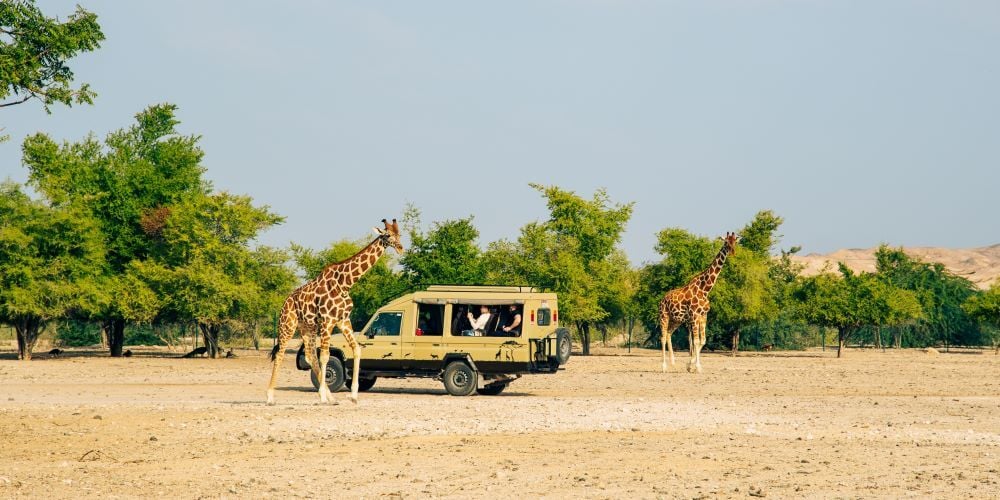
The principal safari excursion, the guided Nature & Wildlife Drive, enters the Arabian Wildlife Park, which covers more than half the island. Thousands of animals roam freely across the reserve, among them Arabian oryx, gazelles, giraffes, ostriches and cheetahs. Visitors travel with guides in specially adapted 4x4 vehicles; private cars remain behind at the mainland jetty. The arrangement is carefully managed, but it does not feel like a conventional drive-through attraction.
The presence of giraffes and cheetahs inevitably gives parts of the drive the look of an African safari, but the island’s history is firmly rooted in Abu Dhabi. Sheikh Zayed created the reserve as part of a wider effort to protect threatened species, most notably the Arabian oryx. That legacy – rather than the simple novelty of seeing wildlife in the Gulf – gives Sir Bani Yas its particular character.
A Conservation Island Shaped by Sheikh Zayed
The long journey west is part of the experience. Sir Bani Yas lies off Jebel Dhanna in Al Dhafra, reached by boat from the mainland after the drive from Abu Dhabi. Sheikh Zayed bin Sultan Al Nahyan established the island as a royal nature reserve in 1971, beginning a conservation project closely associated with the protection of threatened species in the UAE.
Across the Arabian Wildlife Park, Arabian oryx gather in large herds, while giraffes can be seen among the low hills and sandy tracks. The island supports more than 30 species, including ostriches, cheetahs, hyenas and Barbary sheep. The experience feels unusual not simply because of the variety of animals, but because they roam across a broad protected reserve rather than a conventional enclosed attraction.
The Arabian oryx gives the island much of its conservation significance. Declared extinct in the wild during the 1970s, the species became the focus of a breeding and protection programme launched by Sheikh Zayed. On Sir Bani Yas, the animals are not viewed behind glass or confined to a small display. They move across the open ground in groups – a familiar sight on the island now, but one made possible by decades of conservation work.
The Nature and Wildlife Drive
The island is explored with an expert guide in a specially adapted 4x4, the closest practical way to observe wildlife moving across the Arabian Wildlife Park. The reserve is protected, the route carefully managed, and sightings vary with the hour, the weather and the animals’ own movements.
Sandy tracks pass through open ground, planted areas and rougher stretches of terrain, with long intervals between sightings. An oryx herd, giraffe or ostrich may eventually appear, but the animals roam freely and each drive unfolds differently. Much of the pleasure lies in moving carefully through the reserve and waiting to see what appears.
That measured pace gives the drive broad appeal. It suits couples spending a quiet weekend away, families looking for a wildlife experience within the UAE, and solo travellers. For guests staying at one of the island’s three Anantara resorts, it also gives the beach-and-villa stay a closer connection to the conservation project that shaped Sir Bani Yas.
A Quieter Kind of Abu Dhabi Luxury
Sir Bani Yas offers a more restrained form of Abu Dhabi hospitality, shaped by its distance from the mainland and carefully managed access. Anantara operates three resorts on the island, each in a markedly different setting. Al Sahel has 30 safari-style pool villas overlooking the savannah, while Al Yamm is a low-slung coastal retreat beside the beach and mangroves. Desert Islands Resort & Spa occupies the northern shore, with a broader choice of rooms, suites and villas.
For the safari experience, Al Sahel is the natural fit. Its villas sit within the protected reserve, where Arabian oryx and gazelles may wander across the surrounding ground. Wildlife is therefore part of the stay rather than something encountered only during a scheduled drive. A morning in the park might be followed by a few quiet hours beside a private pool or dinner outdoors – an unhurried rhythm that suits the island.
This is where Sir Bani Yas differs from a conventional beach resort. The villas provide the comfort expected at this level, but the protected reserve remains the reason to travel so far west. Privacy comes partly from geography and partly from the way visits are organised, while the island’s conservation purpose remains evident throughout the stay.
Beyond the Safari
Wildlife may be the principal draw, but there is much more to the island than the safari. Visitors can kayak through the mangroves, snorkel around protected reefs or explore the inland terrain on foot, horseback or mountain bike. These experiences give Sir Bani Yas the breadth of a proper island retreat.
Kayaking offers a close view of the mangroves and migratory birds, while walking and cycling routes pass through wadis, beaches and rougher stretches of the reserve. An overnight stay leaves room to arrange the day around the heat and changing light – a morning wildlife drive, perhaps, followed by time on the water later in the afternoon.
The island also holds one of the UAE’s most significant early Christian sites. Rediscovered during excavations in 1992, the church and monastery are thought to have been built around AD 600 and abandoned by about AD 750. Artefacts found there suggest that its inhabitants traded across the Arabian Gulf and Indian Ocean.
The site gives Sir Bani Yas an unexpected historical depth, with traces of worship, settlement and long-distance exchange lying beyond its more immediate wildlife appeal.
How to Visit
Reaching Sir Bani Yas takes some planning. The mainland jetty at Jebel Dhanna lies roughly 250 kilometres west of Abu Dhabi and around 350 to 370 kilometres from Dubai. Depending on traffic and the starting point, the drive takes about two and a half to three hours from Abu Dhabi, or three and a half to four hours from Dubai. Cars are left at the jetty before the final crossing to the island.
Resort guests travel on a complimentary scheduled water taxi, shared with other passengers. The crossing takes roughly half an hour and must be reserved at least 24 hours ahead; timings remain subject to weather and coastguard approval. Wildlife drives and other island activities can then be arranged through the resort.
A day visit is possible, though less straightforward than an overnight stay. Passes are offered through the Anantara activities team, subject to availability, and should currently be booked about a month in advance. Prices vary by season. The package includes the boat crossing from Jebel Dhanna and onward transport from the island jetty.
Staying overnight makes the logistics considerably easier and leaves more room for the island itself. Transfers and activity times can be arranged around the visit, rather than compressed into a single return journey. The cooler months from November to March are the most comfortable for wildlife drives and outdoor activities, and advance booking is sensible during this period.